4 December, 2025
ERS experts urged policymakers to ensure that health is prioritised during discussions on air pollution and emission regulations at the fifth EU Clean Air Forum in Bonn, Germany.
As experts, policymakers and clean air advocates gathered in Bonn (1–2 December) to share insights and explore solutions that aim to ensure cleaner environments for all Europeans, ERS reiterated the inextricable link between air pollution, climate change and health.
The Society also reaffirmed the importance of keeping health at the centre of all discussions on clean air and climate change mitigation policies, including the National Emission reduction Commitments Directive (NECD).
Representing ERS at the EU Clean Air Forum were Professors Barbara Hoffmann and Zorana J. Andersen (the Society’s Advocacy Council Chair and Chair Elect, respectively) and Dr Ulrike Gehring, Chair of the ERS Environment and Health Committee.
Despite progress, air pollution remains a substantial threat to health
Despite recent progress in the EU’s clean air policies, air pollution – including fine particulate matter – still causes hundreds of thousands of premature deaths in Europe each year. It also causes or exacerbates all major health conditions – particularly chronic respiratory diseases such as asthma, COPD and lung cancer.
The economic cost of air pollution is also astronomical. Directly, it costs the EU economy more than €20 billion per year, most of this on our already strained healthcare systems. In addition, indirect costs add up to a staggering €330–940 billion annually (European Commission Impact Assessment Report 2022).
ERS Advocacy Council Chair Elect underlines threat posed by black carbon
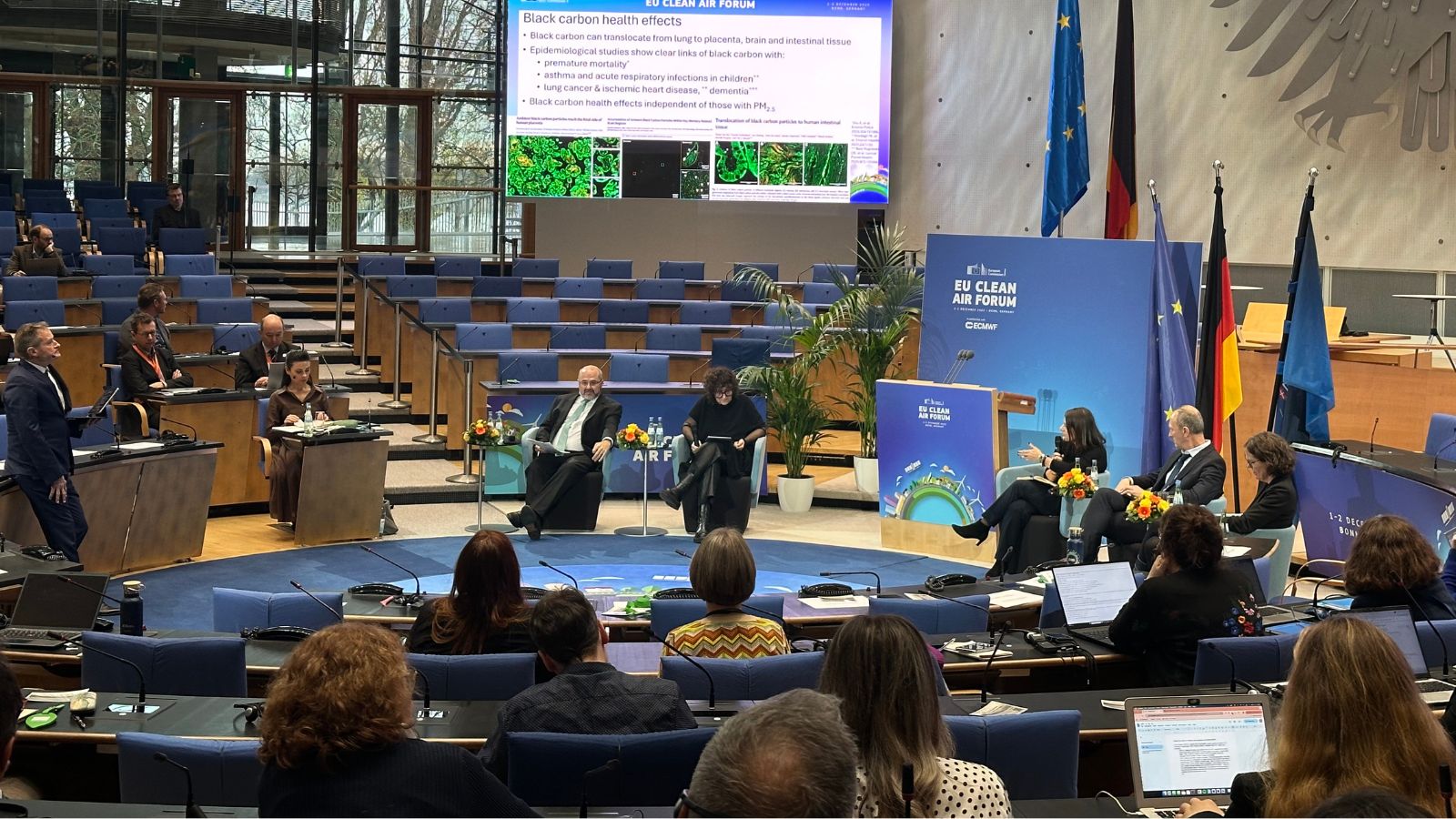
As part of the panel discussion ‘Climate & clean air: tackling super pollutants and extreme events’, Prof. Zorana J. Andersen (Advocacy Council Chair Elect) highlighted the dangers to health posed by black carbon, better known as soot – a component of fine particulate matter (PM2.5).
Prof. Andersen explained that black carbon can move from the lungs to the placenta, brain, and intestinal tissue – indicating a clear link to premature mortality in addition to asthma, acute respiratory infections in children, ischemic heart diseases, lung cancer, and dementia in adults.
Prof. Andersen also stressed that health inequalities caused by significant discrepancies in black carbon emissions between Western and Eastern Europe – including Balkan nations – must be addressed.
Health threats indicate the need for strong clean air policies
ERS is committed to ensuring that clean air policy decisions are led by scientific evidence – with a strong focus on health – and that efforts to reduce harmful air pollution levels continue beyond 2030, when the current NECD expires. Prof. Hoffmann said:
“ERS is committed to making sure that health is always the primary concern when it comes to making decisions on clean air and climate change mitigation policy.
“This is particularly important when it comes to reducing emissions of dangerous pollutants. The current regulation in the National Emission reduction Commitment Directive (NECD) ends in 2030, but further emission reductions are urgently needed in the coming months and years to ensure that all Europeans live in cleaner, healthier environments by 2030 and beyond.
“We will continue to ensure that the health argument is always discussed – the risks to health posed by air pollution and climate change are too significant to ignore.”