13 January, 2026
Respiratory professionals with an interest in chronic cough are encouraged to submit their work to the first ERS Cough Conference, which will take place later this year (15–17 July in London, United Kingdom and online).
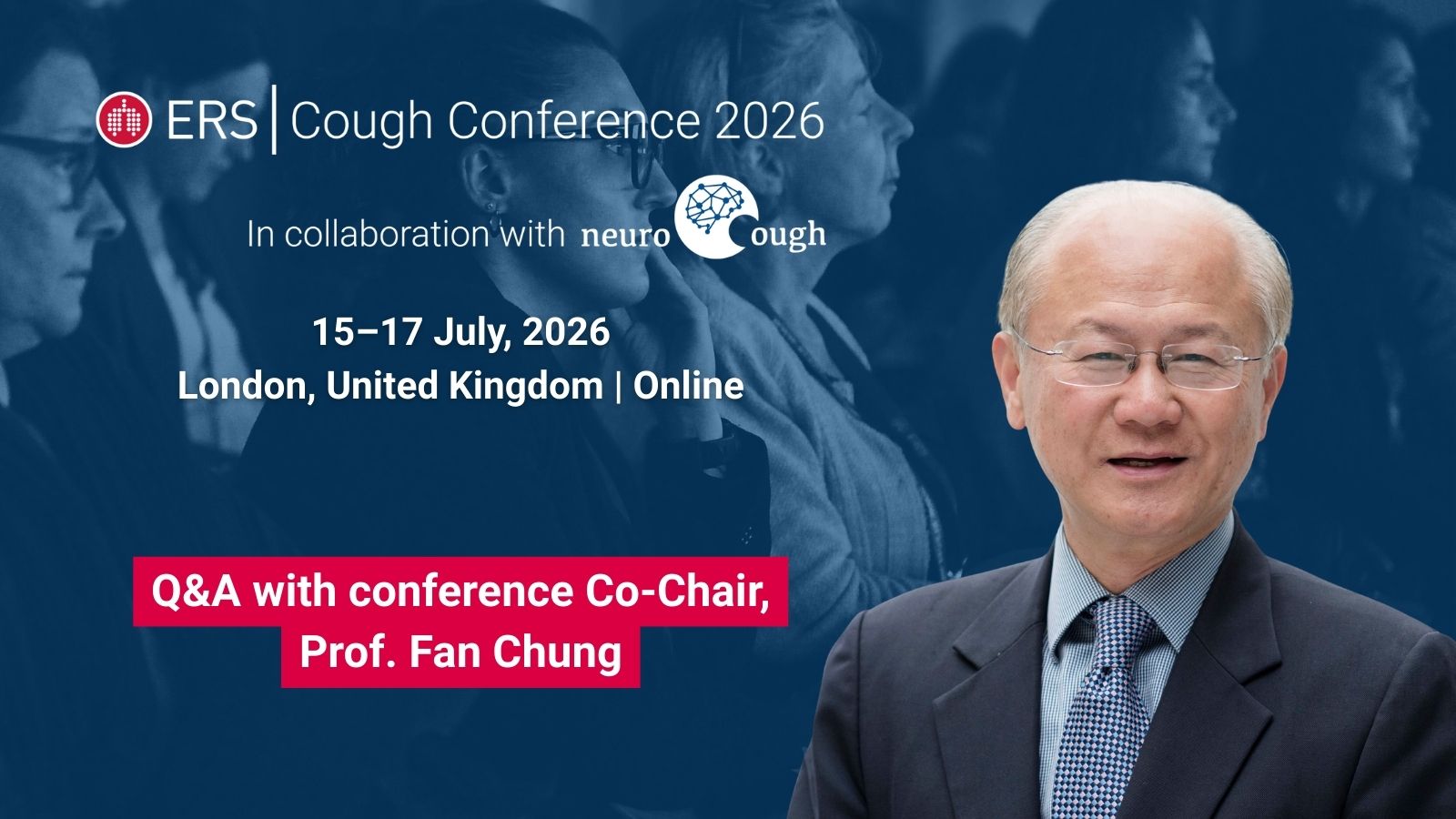
Answering key questions about this event is conference co-chair Prof. Fan Chung, who previously organised the London International Cough Symposium (LICS).
With the ERS Cough Conference acting as a continuation of the biennial LICS, Prof. Chung explains what respiratory professionals will gain from submitting their work for presentation at this inaugural ERS event.
Please explain the background to this new ERS event?
The first ERS Cough Conference will be a continuation of the highly successful biennial London International Cough Symposium that was started in 1998 by the late Prof. John Widdicombe, a pioneer in the field of cough receptors and mechanisms.
Over the past 25 years, there has been tremendous progress in our understanding of chronic cough, in chronic cough as a disease, and in the management of this condition.
The inaugural ERS Cough Conference will be held on the year that would have seen the 14th Symposium. Its aims are the same: to connect patients, clinicians and scientists for a review of the latest clinical and research advances, evolving ideas and new treatments regarding the diseases associated with acute and chronic cough.
Plus, since the condition of chronic cough is now recognised as a distinct disease rather than only as a symptom, another important aim will be to educate on the diagnosis and management of chronic cough across all levels of healthcare.
What can delegates expect from the conference programme?
Delegates can expect state-of-the-art presentations by an international faculty on the cutting edge of our understanding of chronic cough, together with the latest treatment approaches. Conference participants will be informed on:
- Why chronic cough is now considered as a disease
- Its assessment in the clinic
- Our current understanding of its pathophysiology
- The different presentations of chronic cough across the age spectrum
- The treatment and management of this condition.
In addition, delegates will be exposed to sessions that will describe the latest ways of measuring the impact of chronic cough and of recording coughing events, together with describing the latest clinical trials of antitussive treatments, and the potential new treatments that are under investigation. These sessions will also include industry/pharma participation.
There will also be sessions that discuss presentations of the latest research in chronic cough by young clinicians and investigators, and it is important to note that there will be plenty of time allowed for discussion, and question and answer.
Therefore, delegates will not only learn about the most up-to-date approach to diagnosis and management and the most cutting-edge research areas, but also participate in lively discussion and exchange of ideas/views.
Who should submit an abstract to the conference and why?
In particular, we encourage early-career clinicians and investigators to submit their latest findings. If your abstract is accepted, it can be presented as a talk, or as a poster presentation.
The biggest attraction for early-career clinicians or scientists to present at the conference is that this event will be attended by experts in this field – who will provide excellent feedback on work presented. Plus, with the first ERS Cough Conference being held at the Royal College of Physicians in London, there will be plenty of room for poster presentations, and significant time dedicated to discussion.
There will also be prizes for the best presentations, more details for which will be revealed in due course! Submit your abstract before the deadline of 31 January, 2026.
Please explain the event’s partnership with the ERS CRC NeuroCough?
NeuroCough will be an inherent partner of the conference, which will feature presentation of the recent data of the European Chronic Cough database, and ERS efforts to have chronic cough labelled as a disease within the upcoming edition of the WHO International Classification of Disease.
Through the participation of NeuroCough and also the European Lung Foundation, there will be a strong participation of chronic cough sufferers who will participate as speakers and discussants throughout the conference. This will be unique, with such participation being a first for cough conferences.